Introduction
If enabled, Speeder's kernel input allows your mouse and keyboard input to come from a physical mouse and keyboard installed on your computer. This is relatively significant because there will be no difference between a key you physically press and a key simulated by Speeder, preventing the anticheat from seeing the input as simulated.
Speeder, however, does not know exactly which mouse and keyboard you want it to use, so please read on for setup instructions.
Setup
The easiest method to set up kernel input for your specific mouse and keyboard is to use the "Initialize Kernel Input" checkbox in Launcher. Check the checkbox and then click Load Driver. Once your driver is loaded, a message box will appear, asking you to unplug your mouse and keyboard. Do as it says, or if you have a wireless mouse/keyboard, simply unplug the USB dongle and plug it back in. If you are using Bluetooth, turn Bluetooth off and then back on. This sends a "connect" packet through the kernel, which your driver can intercept and thereby know exactly which mouse and keyboard you're using. Once you have unplugged what you need to and plugged it back in, click OK on the message box. You should now see a success message. Kernel input should work at this point, but you can test it by clicking the "Test Mouse/Keyboard" button. Launcher will move the mouse via your driver, check for movement, then press a key on your keyboard via your driver, and check for the keypress.
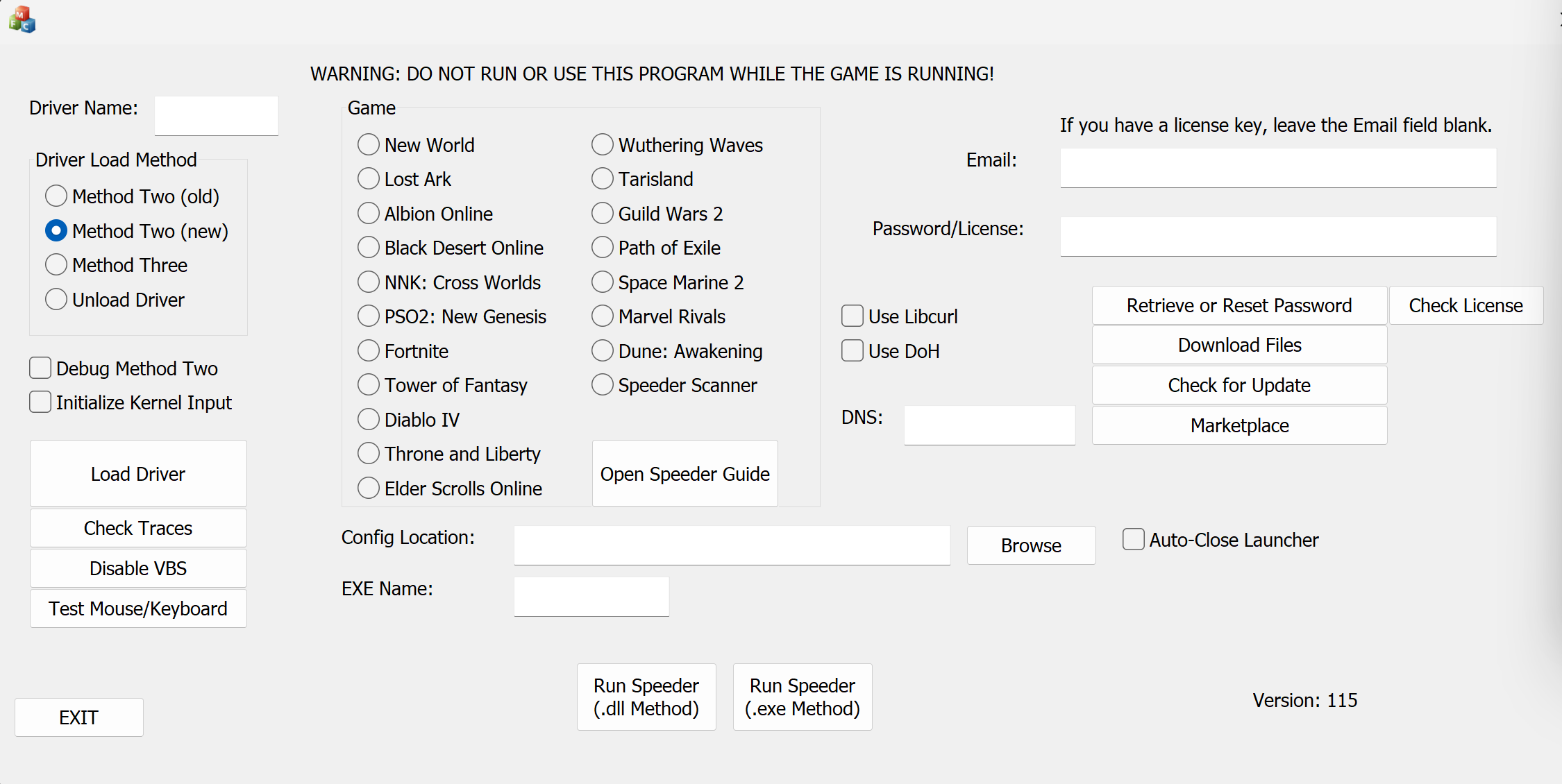
If it fails, check the device names in the Launcher log window. They should read
\driver\mouclass
\driver\kbdclass
If you do not see "mouclass" or "kbdclass," you have keyboard/mouse software on your computer that is interfering with kernel input. The usual culprit is Razer Synapse, which should be uninstalled. If you don't know what the software is, try a Google search for the driver, and you should be able to figure it out. For example, if it says
\driver\keyboard
do a Google search for "keyboard.sys," and you will find that you have Interception installed (which should also be removed).
If you have a laptop and no USB keyboard, this method will obviously not work for the keyboard (since you can't unplug it). However, Speeder will still attempt to find a working keyboard when it first runs. If you are playing an FPS game, you can generally ignore the keyboard anyway since you will only need mouse input.
Setting Specific Devices
If you follow the directions above under "Setup," you do NOT need to set specific devices because Speeder will automatically use the devices you unplugged and plugged back into your computer. However, if you want Speeder to find your mouse and keyboard automatically without having to unplug them every time, you can tell Speeder which devices you want it to use.
To figure out the correct devices, use the RawInput Detector utility here. Run the program as admin, press a key on your keyboard, press a key on your mouse, and you will now have the device names. These names will be automatically copied to your clipboard. At this point, simply open config.txt (or use the -s command for certain games) and paste into the kernel input line. The line will look like
1|\?\hid#bladesysvirthid&col15#1&2e315aa9&0&0004#{814b36c3-57ea-12e1-ba8d-10a3c92415ed}|\?\hid#bladesysvirthid&col12#1&2e515cb7&0&0003#{178ee321-96ea-31d1-ac4c-01a0c93455de}
The syntax of the line is
[enable kernel input]|[keyboard device name]|[mouse device name]
without the brackets, but you don't need to remember this if you follow the directions above.
What Do I Do if It Isn't Working?
Speeder relies on HID devices to send mouse and keyboard input. If you do not have an HID device installed for either your mouse or keyboard, the initialization will fail, and you will not be able to use kernel input. Fortunately, HID devices are extremely common. Most (all?) USB mice and keyboards are HID devices and will work fine with Speeder.
To see the HID devices you have installed on your computer, go to Device Manager and look under "Keyboards" and "Mice and other pointing devices." If you see "HID Keyboard Device" and "HID-compliant mouse," you should be all set.
If you do not have an HID device for either your keyboard or mouse, try to find a USB keyboard or mouse lying around (depending on which you are missing) and plug it in. Chances are it is an HID device and will work fine. Really cheap USB mice and keyboards are almost always HID devices, so, worst case, if you don't have one, you can spend $5 to get one.
If you are unable to use an HID device for some reason, you can set the kernel input setting to 0, and Speeder will use the Windows API to send input. For some games, this is fine and won't raise any red flags, but for others, it can be dangerous. For FPS games or games with an aimbot, I do not allow kernel input to be disabled for safety reasons. Always check the [Safety] section for each game.
Other Problems
Having Interception installed will cause kernel input to fail. Either uninstall or disable it.
Having reWASD installed will cause kernel input to crash your computer. Either uninstall or disable it.
Avast antivirus (and maybe others?) can cause kernel input to fail. If you are having issues, I recommend temporarily disabling your antivirus so you can narrow down the problem. Windows Defender works fine.
Razer Synapse (and maybe other mouse software) can prevent kernel input from working correctly. Simply disable or uninstall Razer Synapse, and you should be all set. Please note that Razer Synapse will often run in the background without you knowing, so be sure to check services.msc, scroll down to Razer, and make sure none of the Razer services are "Running."